Showing posts with label Why and How?. Show all posts

Sunday, December 26, 2010

The Earth is Round, huh?

How was the cartoon characters' invasion of Facebook profile pictures, this December? Every profile you land onto, would have shown you Dexters, Popeye, Scoobies, Tin Tins and several other stalwarts from the Cartoon World, letting us know how people loved (and would love) to revert to their childhood. You do, I bet. Perhaps, for this reason, these kind of high school queries pop up in my mind, then and there. :) Apparently matured science-freaks, stay away. ;)
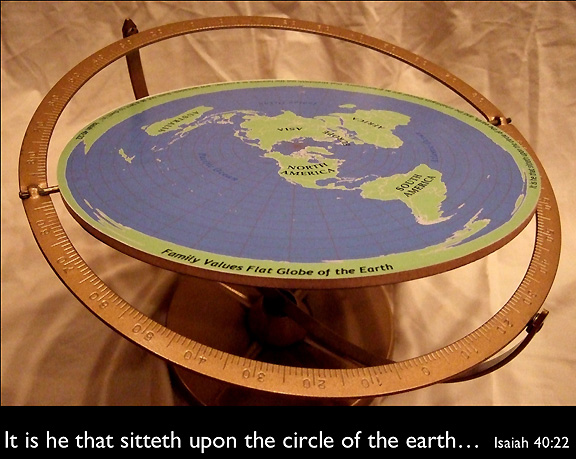
Flat Earth Model
Is the Earth round? Why shouldn't it be flat as it was assumed to be, centuries ago? What bothers the Flat Earth Model? Let me put forth, a few.

The Flat Earth:
Early astronomers, (most of them are actually travelers) who spent most of their time on sea, assumed that the Earth was flat, though their assumption wasn't blind enough to be criticized. 

1. Out of hundreds of ships that start their journey from the same spot, a few were found missing, as they lose their way, get stranded on the sea and die off. This made the other travelers assure, "The horizon is always seen as a straight line bordering the sea and the sky; The ships cross the horizon and fall off the earth into the space", which proved the possibility that the Earth is flat.
Since the earth is flat, ships that cross the horizon(border) fall off the earth into the space and get lost.
2. "According to the Aether Wave Theory, aether- a massless substance pervades all matter and even space(vacuum). If so, it would eventually resist the high pace of revolution of the spherical Earth round the sun; Being a sphere, aether resists its motion", the flat-earth nuts say.

The Spherical Earth:
On the contrary to the Flat Earth model, evolutionary philosophers like Eratosthenes posed a strong contradiction to the pre-existed model. Some of the solid and substantial proofs are as follows.

Lunar Eclipse
1) We all agree that Lunar eclipse occurs only because the shadow of the Earth darkens the Moon, as the earth comes in between the Sun and the Moon. If not the Earth were spherical, the shadow observed would not be a "curve". This affirms that the Earth must be round, i.e, spherical.

2) Mast of Ships coming from a far distance is always seen before the hull. This proves that the Earth is round.

3) A stick casts shadows of different lengths at different places, at a time only because the Earth is round, spherical. If the Earth were flat, the stick would cast shadows of same length everywhere.

4) The geometric shape with minimum surface area is sphere. Every matter, especially liquids tend to get spherical to minimize their surface area. In analogy to this fact, spherical Earth must favor it formation.

5) Pole star(Polaris) is seen straight above the sky when observed from the North Pole, where as it is seen lower in the sky when observed from the Equator. This proves that the earth must be round.

Modern Approach:
Though, these points validate the spherical shape of the Earth, one need a fool-proof experiment to confirm its shape. 

Every satellite image of the Earth, taken from the space or from the moon, show that the Earth is round. Also, the invention of three-dimensional imaging system and geosynchronous satellites add yet another proof to the Spherical shape of the Earth.

Satellite image of the Earth
Also, the weight of an object as measured at the Poles appeared to the greater than that of the Equator. Since, the weight (gravitational force) varies inversely as the distance, heavier weight implies lesser distance. Therefore, the Poles must be relatively nearer to the center of the Earth, than the Equator. Therefore the shape of the Earth must be a sphere compressed at its poles. This shape, known as "Oblate spheroid" is widely accepted as the shape of the Earth. :D

gotcha??

Sunday, August 1, 2010

Why is the night sky dark?

Sitting beside a sea, comforting on the beach sand with legs stretched, relishing the cool sea breeze, peeping at the dark clear night sky pondering something is really exciting, yeah?? 
Ever got such a kinda situation to bask the beauty??

Yeah? But halt here....! Why is night sky always "dark"??? Ever wondered? 
Why, at first look, you might say, "This is too fundamental. Too simple and obvious". But it isn't so simple as it seems to be! This is a famous and not so easy paradox called as "Olbers' paradox" which has just been solved to some agreeable extent.
"Why night sky appears dark, huh?"

When you put forth this question, you are likely to get the most probable explanation, "During night, the sun is on the other side of us. So, we feel the sky dark."

But it is not quite convincing, for we aren't high school kids anymore. Smarter children, who have a good sense of intelligence would pose a contradiction to this explanation, which goes, "Science says that there are over 200 billion stars in our galaxy - the Milky Way. So, what about the light emanating from those stars? Wouldn't they light up the sky??"

If light from almost every star reaches the earth,
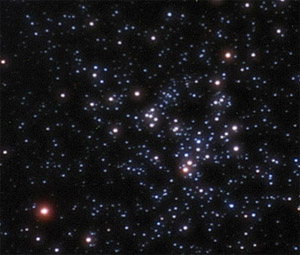
 the sky would look like this.


This question has a salutary logical point. There are almost uncountable number of stars on the sky(in the Universe). These stars, being self-luminous, would definitely give off light which should reach the earth. If this is true, the sky would look at least like this:-(see the image on the right)

But in reality this doesn't seem to be holding good. What has happened to the light rays which have been emanating from these stars? What is preventing them from reaching the earth?

The most expected answer is "Stars(other than the sun) are excessively far from the earth and therefore, the rays exhaling from them suffers an appreciable loss in intensity. So, the night sky is dark". This explanation would render us a little better view on the topic. But what is that which is exactly responsible for such a loss in intensity??


Picture describing Oblers' paradox.
One might say that every galaxy contains more number of planets and other dust particles, than the number of stars. So, these plants, asteroids, comets and dust would simple block "some" of the light rays from the distant stars from reaching the earth. But remember, they block only "some".

Also, the distribution of stars is not uniform, but they hide behind one another so that it solves the paradox to a little extent.

But the main and more accurate answers are as follows:

1)The Universe is expanding. So, light from the distant stars are "red-shifted" to obscurity.
2)The Universe is young. Light from distant stars hasn't even reached us yet!(may sound funny for beginners)

Speaking about the first explanation, the Universe is said to be expanding frantically. The Big Bang Theory supports this view. So, distant stars which are moving at a considerably high speed will be "red-shifted". To elaborate, as these stars are moving at a high speed relative to the earth, the wave-length of the visible light emitted by them would be shifted towards red.(red-shift) 

But some physicists put-forth a counter-argument that light of lower wavelength like gamma rays, x-rays and UV-rays would also be red-shifted to "visible region" and this would compensate the former.

Whatever be it! But the second point has a good significance. The Universe is young and degenerate. So, we only see the part of Universe less than 15 billion light years away. Objects which are more than 15 billion years old are too far away for their light to reach us. 

Thus, Oblers' paradox is somewhat resolved. Contradictory thoughts are welcomed. Cheers......!

__________________________________________________________
(pictures are taken from the web. and link courtesy - wikipedia)

Friday, April 30, 2010

Elliptical Orbit of Planets

Haven't you ever wondered why do planets and other heavenly bodies revolve around the sun?? Do you know why do they rotate themselves?? 


You might find the reason behind why they revolve around the sun or any star in any lower grade geography book. Yeah. 


First let us talk about the condition of planets, stars, asteroids, comets and other heavenly bodies just after the formation of this Universe. According to the Big Bang theory, there were no planets, no stars and other bodies before. Instead, there was a single condensed mass of matter which exploded into millions of pieces. Each piece travelled at a very high speed in a straight line. These pieces were made up of hot gases or primitive particles like protons or helium. On cooling, they condensed again to form rough spherical masses. That's what we call "planet".


Now, while the spherical mass is moving at a high speed in one direction, they are attracted by a  body whose mass is several times heavier than the spherical mass. So the direction of motion of the spherical body tends to change. At one stage, when the velocity of the spherical body(planet) is perpendicular to the force of attraction of the heavier mass(star), the body presumes a circular path. This is the origin of revolution.


This things is what everyone knows, right? But practically most planets have elliptical orbit rather than circular orbits. Why?? Let's see again.


See, as in the previous case, imagine a planet revolving around a star in circular orbit. Now an asteroid or some smaller body hits the planet and gets attached. What happens?? The centre of mass of the planet will be altered.


The sun pulls a planet around itself not by its surface, but by its centre of mass. If the planet's surface were alone pulled by the sun, they the surface would have been detached from the planet and would revolve in a separate orbit. So the sun's gravity acts on the "Centre of mass" of the planet. If the centre of mass of a planet is altered by any means, then the trajectory of the orbit changes to ellipse!


Depending upon the quantity of mass that got added up, the eccentricity of the elliptical orbit of various planets differ.


Visit this site for an interactive study of eccentricity and elliptical trajectory of a planet.


http://windows2universe.org/physical_science/physics/mechanics/orbit/orbit_shape_interactive.html

Tuesday, April 6, 2010

Dissolution Magic!


Just try this at home!

Take a beaker full of water. Note the water initial level. Now, a spoon-full of common salt is added to the beaker and stirred for some-time. After adding more and more common salt, does the water level increase?? 

No! Then, where all the salt has gone??

Think!

See, not only in this case, but the dissolution of any substance into any solvent doesn't necessarily change the volume of the solution. Why?

Let us get into the molecular level. 

In this case, water being polar exists as cross-linked 3-dimensional structure due to inter-molecular hydrogen bonding. Water molecules are scattered into regular pattern with a little inter-molecular space as shown in the following picture. The molecules are a little apart from each other due to electrostatic repulsion between the highly electronegative oxygen atoms. At the same time, these molecules are held by electrostatic attraction between highly electronegative oxygen atom and hydrogen atoms carrying a fractional positive charge.
(before dissolution of common salt) 

After adding few grams of common salt (sodium chloride or NaCl), the molecules of sodium chloride dissociate into Sodium ions and Chloride ions, by Arrhenius' theory of electrolytic dissociation. These Sodium ions and Chloride ions break the regular pattern(arrangement) of water. But these ions need energy to break the bonds between water molecules. They absorb the required energy from the surrounding and thus, water gets cool. Similarly you can feel the coldness when glucose is dissolved in water. 
NaCl(s) → Na+(aq) + Cl-(aq)

Now, these ions occupy the inter-molecular spaces between the molecules of water and so there is no change in the volume of the solution. (See the picture below)
(After the dissolution of common salt)
What difference did you make out between the two pictures?? Yeah~! After dissolution, the solution is more denser than before. So, more energy would be required to boil salt water than pure water. This is called as "elevation in boiling point".

After adding more and more NaCl, at one moment, all the inter-molecular spaces will be occupied. So there is no place for further dissolution. When you add more of NaCl, it just gets precipitated simply, as there is no place to get into! This point is called "Saturation".

Try this for different salts and solvents, but make sure that you don't get them onto your mouth!
________________________________________________________
The second picture has been taken from the web and the third picture has been designed by altering the second picture for better understanding.

Wednesday, March 31, 2010

Why do fans have three blades?


Now, just try to figure this out.. Why do most fans have only three blades? why could it be so?? Hmm...Any idea??

Is there any aerodynamic law that supports the efficiency of using only three blades in electric fans? Think.....! Are you thinking of any kinda complicated theorems in fluid mechanics? Are you trying to solve this query using Bernoulli's principle?

All I can say is that it's a vain attempt!

Actually an electric fan can have any number of blades depending upon certain factors. But, why is it so that most fans have only three blades? Let's see here.

Firstly, the main purpose of an electric fan is to create air-flow. So, a good fan must create a good air-flow with minimal noise. Usually an electric fan has a shaft which is rotated at a moderate speed by an electric motor. The speed of electric fans is chosen in a moderate level for safety purpose and to reduce the noise produced when a fan is operated. There are blades attached to this shaft which rotate along with the shaft.

The number of blades and their shape may vary depending upon the model and aesthetic sense. Even there are certain fans with only one blade. These are usually meant for aeroplane propellers. (see bottom)

Fans may have any number of blades placed at any position. But the weight of the blades must be balanced so that there is maximum efficiency. For that reason, fans with only one blade is not often preferred, as the weight of the blade tend to bend the blade down.
Coming to the arrangement of fans with two blades, it is obvious that these two blades must be oppositely arranged to each other. Similarly in the case of having three blades, each of them must make an angle of 120 degrees with the next blade. 


Now coming to the structure of the blades, each blade is moderately long, thin and bent a little up. Usually metal/alloy blades are preferred for their rigidity and ability to withstand mechanical stress. But, nowadays, there are plastic(polymeric) blades having a comparable strength to metal blades, are used.

Each blade is inclined a bit so that it forces air ahead of it forward. When an electric fan is switched on, the rotation of the blades increases the velocity of the air along the blades (in circular direction) Generally hot air rises upwards. This hot (less dense) air comes to contact with the whirl(rotation) of the blades and are forced back with a little higher pressure. Thus air-flow is created.

An interesting point to note is that an electric fan never creates a cooling effect, by itself. Try switching on a fan in an insulated room. After some time, the temperature will rise a bit. This is because, the electricity used by fan is not completely converted into mechanical energy, as per the second law of thermodynamics. Some amount of the electric energy is converted into heat energy due to the resistance of coil and several other effects and thus the temperature rises. But every-time when we are laid down under an fan, we feel cool breeze, isn't that true? How it happens?

The cooling effect produced by a fan is due to the fact that the air it pushes down makes our sweat evaporate at a faster rate thereby decreasing our temperature. Thus, we feel chill! So, forgot your tension, sit back and relax!

_____________________________________________
Images in the article are taken from the web.


Wednesday, March 24, 2010

Why can't we push a bus from inside?


Now that we are all outing for a picnic. The bus driver shouts as there's a failure in the engine's start-up. We will do what all we can do! Some will panic while some will make others panic and some will shout at the driver and the rest will look cool undisturbed. The most optimistic approach to this situation is pushing the bus till it starts up. We all know that. While everyone is trying to push the bus, what if one pushes the bus from inside??


It's absurd idiot-ism. But "Why actually we  can't move a bus from inside?" Hmm?? Let us give it a try.

According to Newton's first law of motion, "Every body continues to be in the state of rest or in uniform motion, until an external force acts upon it".

Newton has well described the law by including the term "external" which says that there is no change of position of the object( or its centre of mass) without the application of an external force. But what exactly is this "external force"? Well, any "unbalanced" force acting on the system is said to be an external force. 

In order to get a clear picture, we shall compare the properties of internal and external forces. Generally speaking, any internal force is "balanced", i.e, there are forces whose resultant is zero, whereas there is a finite resultant in case of an external force.

When we are pushing the bus from inside, our hands are providing a finite force on the walls of the bus, while our legs are pushing the floor of the bus with more/less the same force. These forces are normal(perpendicular) to each other.

These forces cancel and the resultant comes out to be zero. Hence we cannot move the bus. 
However if there is no friction and if we run from one end of the bus to the other end, the bus moves in the opposite direction so as the keep the centre of mass in the same place. In the absence of any other force, a system tries to keep the centre of mass in the same place despite the action of a small force.

Try running from the back of the bus and jumping into the front side such that your legs hit the front surface in karate style. As no part of your body is in contact with the bus at the instant when you hit the bus, your force is purely external and moves the bus. 

And that's the same reason "why we can't lift the chair in which we are sitting". 

Can you lift yourself?? Just give it a try.

Thursday, March 18, 2010

Why does paper curl when burnt?

Have you ever seen paper curling when it's burnt?
No? It isn't too late. Just try burning a sheet of paper. It curls like this.


But why? 

See, the basic constituents of paper are cellulose fibres and additives like china clay and chalk. Common paper which we use for daily chores, contains around 5% water when dry(believe it or not!) While burning, it loses water and eventually it becomes ash.

Since paper is not a good conductor of heat, heat is not transferred to the entire lamina. When we burn one of the corners, only the region in the vicinity gets heated up and loses water due to dehydration.

The cellulose fibre, being an organic polymer, tends to stretch when it gets heated up while clay and chalk tend to take up(absorb) heat without undergoing any change(state).

As the sheet of paper is being burnt, the heated side loses water faster than the other side. Hot air always rise upwards as it is less denser. Analogous to this, the heated side being less denser tends to rise upwards. But the trace amounts of clay and chalk play a significant role in absorbing the heat supplied. So, the other side tends to remain as it is. Hence it curls upwards.

Now, our part is in analysing the curl of different sheet of paper differing in thickness. It is obvious that thicker paper curls more. This is because, in thick sheets, the two sides are farther apart than in thin sheets.

Also, paper made of different materials will curl to different extent. This can be explained by the percentage composition of water in different types of papers. Percentage of water in dry sheets of paper varies from 2 % - 10%. Newspapers have the maximum percentage of water(around 10%). Even-though we have really "hot-news" on newsprint, it is the coolest paper of all!

Try these for better understanding:

#1. Take a plain sheet of paper and hold it such that the plane is horizontal. Now, burn one of the corners. You will see it curls upwards. Now just turn the sheet upside down(180 degree, it's still horizontal). Even now, it curls upwards. 

#2. Take a thick sheet of paper(post card-thick preferred) and gently wet one of the sides with water. Now, burn it. You can see only the dry part curls.

#3. Roll a sheet of paper and burn it. Curling is seen in that direction which is concave up.