Showing posts with label Astronomy. Show all posts

Sunday, December 26, 2010

The Earth is Round, huh?

How was the cartoon characters' invasion of Facebook profile pictures, this December? Every profile you land onto, would have shown you Dexters, Popeye, Scoobies, Tin Tins and several other stalwarts from the Cartoon World, letting us know how people loved (and would love) to revert to their childhood. You do, I bet. Perhaps, for this reason, these kind of high school queries pop up in my mind, then and there. :) Apparently matured science-freaks, stay away. ;)
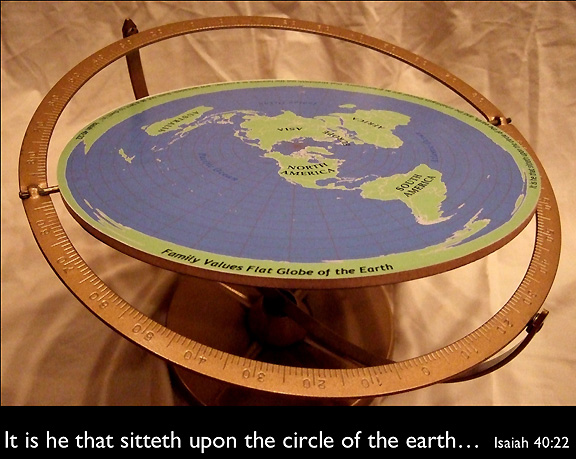
Flat Earth Model
Is the Earth round? Why shouldn't it be flat as it was assumed to be, centuries ago? What bothers the Flat Earth Model? Let me put forth, a few.

The Flat Earth:
Early astronomers, (most of them are actually travelers) who spent most of their time on sea, assumed that the Earth was flat, though their assumption wasn't blind enough to be criticized. 

1. Out of hundreds of ships that start their journey from the same spot, a few were found missing, as they lose their way, get stranded on the sea and die off. This made the other travelers assure, "The horizon is always seen as a straight line bordering the sea and the sky; The ships cross the horizon and fall off the earth into the space", which proved the possibility that the Earth is flat.
Since the earth is flat, ships that cross the horizon(border) fall off the earth into the space and get lost.
2. "According to the Aether Wave Theory, aether- a massless substance pervades all matter and even space(vacuum). If so, it would eventually resist the high pace of revolution of the spherical Earth round the sun; Being a sphere, aether resists its motion", the flat-earth nuts say.

The Spherical Earth:
On the contrary to the Flat Earth model, evolutionary philosophers like Eratosthenes posed a strong contradiction to the pre-existed model. Some of the solid and substantial proofs are as follows.

Lunar Eclipse
1) We all agree that Lunar eclipse occurs only because the shadow of the Earth darkens the Moon, as the earth comes in between the Sun and the Moon. If not the Earth were spherical, the shadow observed would not be a "curve". This affirms that the Earth must be round, i.e, spherical.

2) Mast of Ships coming from a far distance is always seen before the hull. This proves that the Earth is round.

3) A stick casts shadows of different lengths at different places, at a time only because the Earth is round, spherical. If the Earth were flat, the stick would cast shadows of same length everywhere.

4) The geometric shape with minimum surface area is sphere. Every matter, especially liquids tend to get spherical to minimize their surface area. In analogy to this fact, spherical Earth must favor it formation.

5) Pole star(Polaris) is seen straight above the sky when observed from the North Pole, where as it is seen lower in the sky when observed from the Equator. This proves that the earth must be round.

Modern Approach:
Though, these points validate the spherical shape of the Earth, one need a fool-proof experiment to confirm its shape. 

Every satellite image of the Earth, taken from the space or from the moon, show that the Earth is round. Also, the invention of three-dimensional imaging system and geosynchronous satellites add yet another proof to the Spherical shape of the Earth.

Satellite image of the Earth
Also, the weight of an object as measured at the Poles appeared to the greater than that of the Equator. Since, the weight (gravitational force) varies inversely as the distance, heavier weight implies lesser distance. Therefore, the Poles must be relatively nearer to the center of the Earth, than the Equator. Therefore the shape of the Earth must be a sphere compressed at its poles. This shape, known as "Oblate spheroid" is widely accepted as the shape of the Earth. :D

gotcha??

Sunday, August 1, 2010

Why is the night sky dark?

Sitting beside a sea, comforting on the beach sand with legs stretched, relishing the cool sea breeze, peeping at the dark clear night sky pondering something is really exciting, yeah?? 
Ever got such a kinda situation to bask the beauty??

Yeah? But halt here....! Why is night sky always "dark"??? Ever wondered? 
Why, at first look, you might say, "This is too fundamental. Too simple and obvious". But it isn't so simple as it seems to be! This is a famous and not so easy paradox called as "Olbers' paradox" which has just been solved to some agreeable extent.
"Why night sky appears dark, huh?"

When you put forth this question, you are likely to get the most probable explanation, "During night, the sun is on the other side of us. So, we feel the sky dark."

But it is not quite convincing, for we aren't high school kids anymore. Smarter children, who have a good sense of intelligence would pose a contradiction to this explanation, which goes, "Science says that there are over 200 billion stars in our galaxy - the Milky Way. So, what about the light emanating from those stars? Wouldn't they light up the sky??"

If light from almost every star reaches the earth,
 the sky would look like this.


This question has a salutary logical point. There are almost uncountable number of stars on the sky(in the Universe). These stars, being self-luminous, would definitely give off light which should reach the earth. If this is true, the sky would look at least like this:-(see the image on the right)

But in reality this doesn't seem to be holding good. What has happened to the light rays which have been emanating from these stars? What is preventing them from reaching the earth?

The most expected answer is "Stars(other than the sun) are excessively far from the earth and therefore, the rays exhaling from them suffers an appreciable loss in intensity. So, the night sky is dark". This explanation would render us a little better view on the topic. But what is that which is exactly responsible for such a loss in intensity??


Picture describing Oblers' paradox.
One might say that every galaxy contains more number of planets and other dust particles, than the number of stars. So, these plants, asteroids, comets and dust would simple block "some" of the light rays from the distant stars from reaching the earth. But remember, they block only "some".

Also, the distribution of stars is not uniform, but they hide behind one another so that it solves the paradox to a little extent.

But the main and more accurate answers are as follows:

1)The Universe is expanding. So, light from the distant stars are "red-shifted" to obscurity.
2)The Universe is young. Light from distant stars hasn't even reached us yet!(may sound funny for beginners)

Speaking about the first explanation, the Universe is said to be expanding frantically. The Big Bang Theory supports this view. So, distant stars which are moving at a considerably high speed will be "red-shifted". To elaborate, as these stars are moving at a high speed relative to the earth, the wave-length of the visible light emitted by them would be shifted towards red.(red-shift

But some physicists put-forth a counter-argument that light of lower wavelength like gamma rays, x-rays and UV-rays would also be red-shifted to "visible region" and this would compensate the former.

Whatever be it! But the second point has a good significance. The Universe is young and degenerate. So, we only see the part of Universe less than 15 billion light years away. Objects which are more than 15 billion years old are too far away for their light to reach us. 

Thus, Oblers' paradox is somewhat resolved. Contradictory thoughts are welcomed. Cheers......!

__________________________________________________________
(pictures are taken from the web. and link courtesy - wikipedia)

Friday, July 23, 2010

Jupitor's stripe plays Hide and Seek game with Skywatchers!


Yeah. I am sure, I'm not kidding. But you have to believe that "One of the two equatorial belts, a thick stripe that encircles the Jupiter has played "hide-and-seek" game with astronomers and sky-watchers".

Figure showing the lower equatorial belt missing.(right)
Any amateur sky-watcher, if witnessed the giant planet through an astronomical telescope for the first time, could identity it only after confirming the presence of those two deep wide stripes that encircle the planet. They call it as "the equatorial belts". These belts usually contain fast moving jet stream of gases that fill up the planet's atmosphere. 

But what has happened on the previous may storms the sky-watchers and astronomers. Yup. One of the two dark stripes on the Jupiter was found missing!!!

Even a side-line sky watcher with a small telescope on his garden could distinguish the difference since, the stripe plays a significant role in the planet's physique. The absence of the stripe on the planet gave the a different view to the cosmologists.

"WTH?? Even we play x-box, play-station games and it's been ages we forgot the old hide and seek game", said the member of "Game-geek kids' association". :D

"So, my science teacher was correct. The Jupitor must really be very old. Now I can understand it from the fact that it plays 'hide-and-seek" games", says the head of the Game-geek kids' association. :D


Where it could have gone?? This perplexing question made most of the sky-watchers stir up their minds in search of the reason. But some geeky, well informative, intelligent, resourceful and clever Astrophysicists never showed any feeling of being surprised. "The planet has lost this stripe before, most recently in the 1970s and the early '90s. So far, the stripe has always reappeared", they said.

Whatever be it. But what is the reason behind this strange occurring? Scientists are  stumped for a complete explanation of this incident. Some amateur cosmologists put forth their view that the stripe, a part of the Jupiter's atmosphere could have moved somewhere. But that is not completely possible in the Jupiter.

Unlike the earth's atmosphere, Jupiter's atmosphere cannot move much distance, on account of the planet's iron clutching heavy gravity. The reason for this weird happening was anyway figured out after a month by Hubble Space Observatory.

"The Jupiter's atmosphere, the largest planetary atmosphere of the Solar System is mainly composed of molecular hydrogen and helium with a trace amount of ammonia, hydrogen sulphide and methane", wiki says.

The images captured and published by the Hubble Space Observatory reveals the mystery. "The stripes are hidden behind the white ammonia ice crystal clouds, which are present in the atmosphere obscuring the view", says Hubble Space scientists.

The team has also predicted that the cloud which is obscuring stripes should clear out in a couple of months. I'm sure their prediction will obsoletely be perfect.

Err..I want Hubble to set up a new crew for finding a better place to live! This old spoiled Earth is already stinking up, with all kinds of pollution and frantically increasing population. Seriously we need an alternate. Do you know any?? :D ??


______________________________________________________________


Data and image courtesy: wired science, wiki, national geographic news.

Thursday, July 22, 2010

A Massive Star Revealed

Giant stellar nursery surrounding the new star NGC 3603
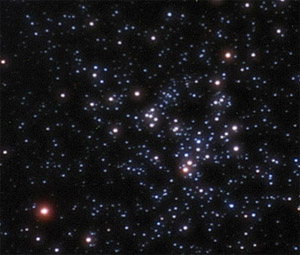
A team of astrophysicists, under the leadership of Paul Crowther, has revealed to the world, two young cluster of stars, NGC 3603 and RMC 136a. The twins are found fit to be called the "Super-heavy weight champions" of the observable parts of the Universe.


The crew of astronomers has used European Southern Observatory(ESO)'s Very Large Telescope(VLT) as well as archival data from the NASA/ESA Hubble Space Telescope to analyse the different parameters of the newly discovered stars. The statistically verified data put forth by the crew about the masses and luminous intensity, surprises the astronomers all over the world.


Out of the two, the star NGC 3603 seems to be a cosmic factory from where a cluster of stars frantically emanate, from the nebula's extended clould of gas and dust, located 22,000 light years from the Sun.

The Massive star clusters on Large Megallanic Cloud.
It's counter-part RMC 136a(fondly called R136) is found to be another cluster of hot and massive stars, well located inside the Tarantula Nebula, in the large Megallanic Cloud, at a distance of 165,000 light years from the sun. It is also noteworth that this Megallanic Cloud, is one of the neighboring galaxies of our Milky way.

The team has also put forth a sum-up data of the images captured by the ESO's VLT which reveal that these stars weigh 265 times the mass of the sun. This data has traumatized several scientists and astronomers who reckoned that the most massive of all stars would not weigh more than 150 solar masses.
To their surprise, the birth masses of these two stars, estimated by the crew is close to 320 solar masses.

"Unlike humans, these stars are born heavy and lose weight as they age" says, Dr.Paul Crowther, Astrophysicist. Yup. It makes a point, though seems to be funny.

"Being a little over a million years old, the most extreme star R136a1 is already 'middle-aged' and has undergone an intense weight loss programme, shedding a fifth of its initial mass over that time, or more than fifty solar masses", added Dr.Paul Crowther.

What if such a massive star be taking the place of our sun?? Mind-blowing, isn't it??

"Its high mass would reduce the length of the Earth's year to three weeks, and it would bathe the Earth in incredibly intense ultraviolet radiation, rendering life on our planet impossible," says Rapheal Hirschi from Keele University, who was one among the crew members.

Not just this discovery, but the team has also predicted how massive a star could be, withing this cluster. "The smallest stars are limited to more than about eighty times more than Jupiter, below which they are ‘failed stars’ or brown dwarfs," says Olivier Schnurr, from the Astrophysikalisches Institut Postdam.

As the Indian Astrophysicist Dr.Subrahmaniyan Chandrasekhar quoted, less massive stars, having their masses less than 8 solar masses would shed enough mass, eventually become white dwarf. He has also added that more massive star of masses close to 150 solar masses would ultimately become either neutron-star or a black-hole. This theory is well known to the world as "Chandrasekhar's limit". Now the question is about the stability and existence of these lately discovered stars which weigh almost 300 solar masses. This fact poses the previous theory, a contradiction, which would be solved soon, I guess.


But the sad part about these stars is that they will "die soon". Yup. But don't panic. In astronomy, 3 million years is really short. And that could be the clue. Small life-span of these stars could be the reason why such massive stars are not being witnessed then and there. These are rare and are found only on densest clusters of the Universe. 

But, what is the use of these stars being several times luminous than the sun?? People of this generation never show any interest in comprehending  these kind of stars. Instead, they show a huge craze on cine-stars and pop-stars. Cheers. \m/
______________________________________________________________